What is factoring? It means selling your unpaid customer invoices to a factoring company at a discount, so most of the cash arrives now instead of 30 to 90 days later. The factoring fee is a percentage of the invoice value, often charged for each period the invoice stays unpaid, so a 3% fee on a $10,000 invoice is $300.
What Is Factoring? How It Works, Step by Step #
Factoring follows a fairly fixed sequence, though the details vary by provider.
- You deliver a product or service and issue an invoice with normal payment terms, such as net 30 or net 60.
- You submit the invoice to a factoring company. The factor checks the invoice and, more closely, the credit of the customer who owes it.
- If approved, the factor advances most of the invoice value to your account and holds back the rest as a reserve.
- Your customer pays the invoice. In most arrangements the customer is told to remit to the factor directly, or to a lockbox the factor controls.
- When the invoice is paid, the factor releases the reserve to you, minus its fees.
Because the factor is buying the right to collect on your receivables, it usually files a UCC financing statement against them. That public filing is notice to other creditors that the factor has a claim on those accounts. The rules for these filings and the priority they create are set out in Article 9 of the Uniform Commercial Code.
What a Factoring Fee Includes #
The headline factoring fee is usually a discount rate charged per period, often per 30 days. Before you sign, ask for the full list of charges, because the discount rate is rarely the only cost. Common extras include:
- Setup or application fees
- Processing or service fees on each invoice
- Wire or ACH transfer fees
- Minimum monthly volume fees if you send fewer invoices than agreed
- Credit-check fees on each customer
- Late or extension fees if an invoice ages past the contract period
A 3% discount per 30 days works out to about 36% a year on a simple basis, before any extras. That is not a flaw in factoring; it is the price of speed and of lending against your customers' credit rather than your own. The point is to compare that figure with the other options on the same annual basis.
Worked Example: Cost of Factoring an Invoice #
Suppose you have a $10,000 invoice on net 30 terms. The factor advances 90% at funding, so you receive $9,000 right away. The remaining $1,000 is the reserve.
Your customer pays on day 45. The contract charges 3% for each 30-day period, and a partial period counts as a full one. That is two periods, so the fee is 3% × 2 × $10,000, or $600.
When the customer pays, the factor keeps its $600 fee and releases the $1,000 reserve less that fee, which is $400. Your total from the invoice is $9,000 plus $400, or $9,400.
You paid $600 to receive $9,000 fifteen days sooner than you otherwise would have, plus the reserve back. Whether that is worth it depends on what the cash lets you do. If the $9,000 covers payroll that would otherwise be late, or lets you take a discounted supplier price, the cost may be justified. If you could have waited, it may not be.
Factoring Compared With Bank and SBA Funding #
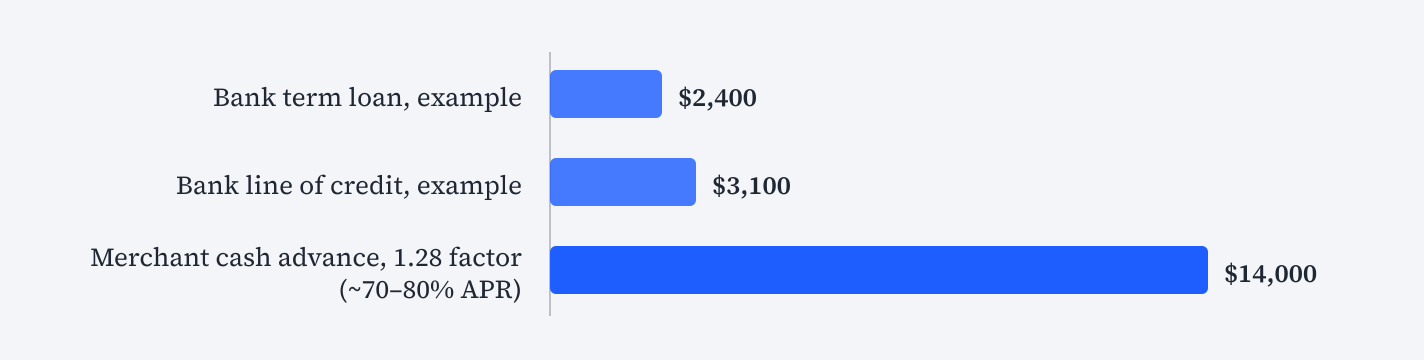
Factoring is one option among several. The table below shows typical costs in plain terms. Dollar examples are illustrative and use a $50,000 need over 8 months.
| Option | Typical cost | Speed | What it needs |
|---|---|---|---|
| Factoring | A percentage of each invoice, often per 30 days (for example 3%, about 36% a year on a simple basis) | Often within a few business days after setup | Invoices owed by creditworthy customers, plus invoice and delivery records |
| Bank term loan | Interest plus fees; for example, about $2,400 on $50,000 over 8 months (illustrative) | Often weeks to months | Time in business, financial statements, a credit history, and often collateral or a personal guarantee |
| SBA 7(a) loans | The lender's rate, within SBA limits, plus any program fees | Often several weeks or longer | Eligibility under SBA size and use rules, a business plan, and full lender underwriting |
| Bank line of credit | Interest on amounts drawn plus fees; for example, about $3,100 on $50,000 drawn over 8 months (illustrative) | Setup can take weeks; draws are quick once approved | A credit review, financial statements, and usually an annual renewal |
| Merchant cash advance | A factor rate; for example, 1.28 factor on $50,000 is $14,000 in total cost, roughly 70–80% APR over 8 months | Often within days | Card sales or bank deposit history, with repayment taken from daily sales |
| Invoice financing (borrowing against receivables) | Interest or fees on advances against invoices; often lower than full factoring because you keep collections | Often within days | Invoices, an aging report, and lender review of your receivables |
A few notes on the table. A factor rate is not an interest rate, which is why each factor figure above carries its approximate APR beside it. A 1.28 factor on $50,000 means $64,000 repaid. Spread over 8 months, that works out to roughly 70–80% APR.
SBA 7(a) loanss are the main SBA program for general business needs. The SBA guarantees part of a loan that a participating lender makes, which can allow longer terms and lower rates than many non-SBA options, but the application is slower and documentation is heavier. The Federal Reserve's Small Business Credit Survey tracks how small firms apply for financing and how online lenders' costs compare with bank loans, which is useful background before you decide.
Figure: the illustrative $50,000 comparison from the table above.
When Factoring Is the Right Tool #
Factoring tends to fit when several conditions are true at once:
- You sell to other businesses or government buyers on invoices with 30 to 90 day terms.
- Your customers pay reliably, even if slowly.
- Your bottleneck is cash timing, such as covering payroll or materials while invoices age.
- Your margins are wide enough to absorb a fee for each period an invoice stays open.
- Your growth means more sales each month, and each new invoice adds to the cash you are waiting on.
Factoring is a weaker fit when your sales are paid at the counter or by card, when a customer dispute is pending on the invoices you would sell, or when your margins are so thin that a few percent per period would erase the profit on the job.
When a Bank Loan or Line of Credit Is the Better Choice #
A bank loan, an SBA loan or a line of credit is often the better tool when you can qualify and the need is not urgent. Bank products usually carry lower costs per dollar than factoring, and they do not depend on your customers' payment habits.
A term loan suits a defined purchase that pays back over years, such as equipment or a building improvement. The SBA's 504 program is designed for major fixed assets like real estate and equipment, and its structure differs from a standard bank loan. The SBA 7(a) program covers a wider range of uses, including working capital, and it can be a good route when a conventional bank loan is out of reach but your credit profile is sound.
A line of credit suits recurring gaps, such as seasonal inventory swings, because you draw only what you need and pay interest on the drawn amount. Its trade-off is an annual review and the need to keep your financial records current.
For smaller needs, SBA microloans of up to $50,000 are available through nonprofit intermediaries. Free counseling from a Small Business Development Center can help you prepare a request for any of these options, and SBA's Lender Match tool connects you with participating lenders. Taking a few weeks to compare these routes often saves more than a quick but costly advance.
Can I Factor Only Some of My Invoices? #
Yes, many factoring companies offer spot factoring, which lets you choose individual invoices rather than your whole receivables book. This is useful when one large or slow-paying account is the problem and the rest of your invoices are fine. The trade-off is usually a higher rate on each invoice and more paperwork per deal. Some factors require a minimum volume or a whole-ledger contract, so read the agreement before assuming you can pick and choose.
What is the difference between factoring and a bank loan? #
A bank loan gives you borrowed money that you repay on a schedule, usually with interest, and it counts as debt on your books. Factoring is a sale of an asset, the invoice, at a discount. The factor's return comes from that discount rather than from interest on a balance. Bank loans are usually cheaper per dollar when you qualify and have time to wait for approval. Factoring is usually faster, and it relies more on your customers' credit than on your own.
How is a factoring fee calculated? #
Most factoring fees are a percentage of the invoice face value, charged for each period, often 30 days, that the invoice stays unpaid. A 3% fee on a $10,000 invoice unpaid for one period is $300. Unpaid for two periods, it is $600. Ask whether a partial period counts as a full one, and whether setup, processing, wire or minimum monthly fees apply. Request the all-in cost in writing, in dollars as well as a percentage, before you compare providers.
Does factoring affect my customer relationships? #
It can. In a notification arrangement, your customer is told to pay the factor directly, so they will know you use financing. Some factors offer confidential or non-notification options, though these usually cost more or come with stricter limits. Ask how the factor handles collection calls before you sign. A poorly handled call to your customer reflects on your business, not on the factor.
Is factoring the same as a merchant cash advance? #
No. Factoring is based on invoices your business has issued to customers who owe you money. A merchant cash advance buys a portion of your future sales, often card sales, and is repaid by holding back a share of daily receipts. Both can look modest per period while adding up quickly. A 1.28 factor on $50,000 over 8 months is roughly 70–80% APR, so compare total dollars and APR-equivalents rather than the factor alone.
Deciding Whether Your Invoices Should Be Factored #
Factoring makes sense when your business sells on credit terms, your customers pay reliably, and slow receivables are holding back payroll or inventory. It is a poor fit when your revenue comes from cash or card sales, when your margins cannot carry a fee for each period, or when a dispute is open on the invoices you would sell.
A bank loan, SBA loan or line of credit may be the better choice when you can qualify, the need is long-term, or you want the lowest cost for an investment that pays back over time. Those routes take longer and require more documentation. A counselor at a local Small Business Development Center can help you compare them against factoring.
If your open invoices are the bottleneck, start your request.
Sources #
This explainer is general information, not advice for your situation. Only an agreement you put your signature on decides which terms apply to you. How this site is paid.