What is a hard money loan? It is a short-term loan from a private lender, usually secured by real estate, and approved mainly on the property's value rather than your credit history or cash flow. Pricing is usually interest plus origination points paid up front.
What Is a Hard Money Loan and How Does It Work? #
The lender starts with the asset. It orders an appraisal, measures how much of the property's value the loan would cover, and sizes the loan from that. Your credit score and cash flow still get a look, but they carry less weight than they would in a bank's decision.
The loan is secured by a mortgage or deed of trust on the property. If payments stop, the property is the lender's main protection. That is why the lender asks about your exit: how the loan gets repaid, usually by a sale or a refinance into longer-term financing. Terms are measured in months, not years.
Businesses can use it too. A company that owns its building, or an owner with equity in real estate, may qualify on that collateral.
What It Costs: Points, Interest and Fees #
Hard money has two main cost parts. Interest is charged on the balance, usually quoted per year and often paid monthly, sometimes interest-only. Origination points are a one-time fee, with each point equal to 1% of the loan, paid at closing.
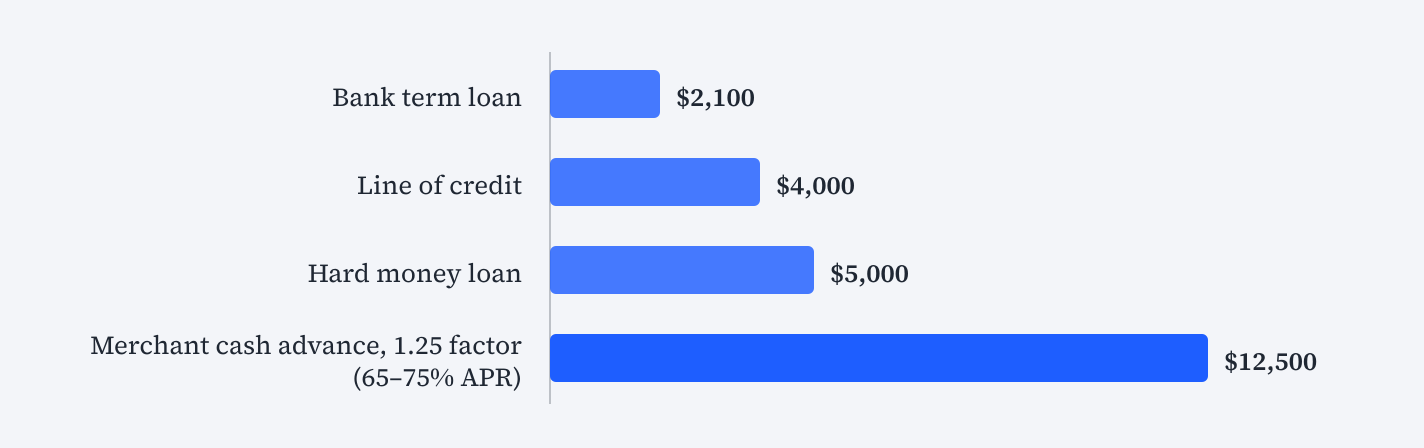
Take a worked example. You borrow $50,000 for eight months at 12% interest, interest-only, with 2 points. Interest totals $4,000 and the points add $1,000, so the total cost is $5,000. That is roughly 15% a year on a simple basis, before other closing costs.
Merchant cash advances are priced differently, with a factor rate instead of an interest rate. A 1.25 factor over 8 months (about 65–75% APR) on $50,000 means you repay $62,500, a $12,500 cost. Always ask for the APR-equivalent before comparing.
The table compares typical costs. The dollar figures are illustrative for $50,000 over eight months, not quotes.
| Option | Typical cost | Speed | What it needs |
|---|---|---|---|
| Hard money loan | Interest plus origination points up front; for example, 12% plus 2 points, about $5,000 total | Days to a few weeks | Property equity and a clear exit plan |
| Bank term loan | Bank's rate and fees; for example, 10% APR, about $2,100 in interest | Often weeks to months | Financial statements, cash flow, credit history |
| SBA 7(a) loans | Lender's rate within SBA limits, plus any SBA fees | Usually weeks to months | Small-business eligibility and full documentation |
| Business credit line | Interest on the drawn balance; for example, 12% fully drawn, about $4,000 | Weeks; reusable once open | Revenue history and credit review |
| Conventional mortgage | Interest over a long term with monthly payments | Usually a month or more | Income, credit and a down payment |
| Bridge loan | Interest plus fees over a short term | Days to weeks | Property and a planned sale or permanent loan |
| Merchant cash advance | Factor rate; for example 1.25 over 8 months, about 65–75% APR | Often days | Card sales or bank deposit history |
Hard Money vs. Bank Term Loans #
A bank term loan is usually the cheaper money. In the example, the bank loan costs about $2,100 in interest against $5,000 for hard money. When you can get a bank loan, that gap is the main reason to take it.
The trade is time and paperwork. A bank reviews financial statements, cash flow and history, and that takes weeks to months. Hard money decides mainly on the property. If your deal must close in two weeks, that speed can outweigh the cost gap.
The FDIC's small business lending survey tracks how banks lend to small firms, including how quickly they decide and how bank size matters. The Federal Reserve's Small Business Credit Survey tracks which lender types small firms approach and how often they are approved.
Hard Money vs. SBA 7(a) and Lines of Credit #
The SBA's 7(a) program is a widely used loan program. The SBA guarantees part of the loan, which lowers the lender's risk. Terms can run far longer than hard money, and the lender sets the rate within SBA limits. The cost is more paperwork, a longer wait and eligibility rules.
A business line of credit is different. You get an approved maximum, pay interest only on what you draw, and can borrow again as you repay. For uneven, short-term needs, that can cost less than a lump sum. For one property purchase, a line may not stretch far enough.
Hard money gives one lump sum on a short, fixed term. It costs more per dollar and usually comes with a deadline. It suits a single job with a known end.
When a Hard Money Loan Fits #
Hard money makes sense when several of these are true:
- Speed matters more than price, such as an auction purchase with a short deadline.
- The property is unusual or needs work that a bank will not finance.
- Your credit or cash flow would slow a bank decision, but the property has real equity.
- You have a clear exit, either a sale or a refinance you expect to qualify for.
- The short term gives you time to finish a renovation or stabilize a building before repayment.
Where a Bank or SBA Loan Comes Out Ahead #
Choose a bank, SBA loan or line of credit when you qualify and can wait. The monthly cost is lower, the term is longer and the total dollar cost is usually smaller.
For owner-occupied real estate and major equipment, the SBA's 504 program is built for fixed assets and may be worth a look. Free counseling through local Small Business Development Centers can help you prepare a request before you apply anywhere.
How to Compare Offers Before You Sign #
Compare total dollars, not the headline rate. Add up interest, points, fees and any minimum interest charge. Ask when points are due and whether any are refundable.
Ask about prepayment. Some loans charge a fee for early payoff. Read the late-payment and default terms, and find out whether a personal guarantee applies. Get the full term sheet in writing.
Convert every quote to an annual rate so the offers can be compared side by side. If a lender quotes a factor rate, ask for the APR-equivalent in writing.
If your cash is tied up in slow-paying customers rather than a property, what is factoring covers a different tool. For invoices, invoice factoring vs invoice financing compares the two options.
Is a hard money loan the same as a bridge loan? #
Not exactly. A bridge loan describes the purpose: short money that covers the gap until a sale or permanent loan closes. Hard money describes the source: a private lender that decides mainly on the property. Many bridge loans are hard money loans, but banks also offer bridge loans. Check the terms, not the label.
How much does a hard money loan cost compared with a bank loan? #
In the illustration above, the hard money loan costs about $5,000 in interest and points on $50,000 over eight months. A bank term loan at 10% APR costs about $2,100 in interest. Hard money is more expensive, and points are paid up front. Whether that premium is worth it depends on what a missed deadline would cost you.
Can a business use a hard money loan, or is it only for real estate investors? #
Businesses use hard money, and the property is usually the reason for approval. A company that owns a building, or an owner with equity in real estate, may qualify for a business-purpose loan. Investors are a common group of borrowers, but a business can apply too. Ask the lender which collateral it will accept.
What happens if I miss a payment on a hard money loan? #
The loan contract sets the consequences. Expect late fees and possibly a higher default rate. Because the loan is secured by the property, a serious default can lead to foreclosure under the mortgage and state law. Read the default section, ask about cure periods and notice requirements, and have a lawyer review anything unclear. Talking to the lender before a payment is late usually leaves more options open.
How fast can a hard money loan close? #
Days to a few weeks is common once the property is identified and documents are ready. The timeline depends on the appraisal, title search, insurance and the lender's review. Gathering documents early, including a project plan and proof of funds for the down payment and costs, speeds things up. Confirm the closing date in writing before you commit to a purchase deadline.
Our Take: Hard Money Is a Tool for One Job, Not a Default #
Hard money fits a specific job with a known end, a property with equity behind it, and a deadline a bank cannot meet. It does not fit a need you can cover with a cheaper loan, or a business that would carry the debt for years on a thin margin. If you can wait and qualify, a bank or SBA loan is usually the better buy. When you are ready to test real numbers against your situation, start your request.
Sources #
The piece you are reading is general guidance only, and not advice about your situation. Only an agreement you put your signature on decides which terms apply to you. How this site is paid.